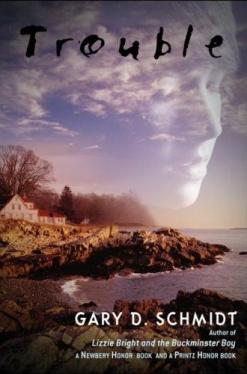
There’s no escaping trouble no matter how far we try to move from it. Nevertheless, some will try. They’ll try to find a place where everybody appears comfortable, where everyone’s the same. They avoid neighborhoods and people who might be trouble or bring trouble. But trouble can wriggle its way into everyone’s life no matter how far you move and how safe you try to make your life. This premise, which unfolds in Gary D. Schmidt’s novel so aptly entitled Trouble, takes readers on a journey that confronts trouble as it careens down a road to turn the life of fourteen-year old Henry Smith upside down. As readers discover the insidious nature of trouble, they also discover how bigotry and economic disparity make trouble even uglier and horrific. They discover that developing understanding and friendship can ease trouble and even save lives.
Although Henry’s father believes he’s moved his family far enough away from trouble to live in their upper-crust town, Henry learns the hard lesson that trouble will find you after his older brother Franklin is struck down by a car driven by Cambodian immigrant Chay Chouan, who attends Franklin’s preparatory school. Readers are quickly caught up into the grief taking hold if Henry and his family and the town’s demand for retribution that exceeds justice. It was a surprise to discover I was suddenly in the midst of a novel that is really about multicultural understanding after the accident sparks bigotry and hatred in the school—and in the town where Henry’s family has lived for generations. “Caught between anger and grief, Henry does the only thing he feels he can: he sets off for Mt. Katahdin, which he and Franklin had planned to climb together. One July morning, he strikes out for Maine with his best friend and the loveable stray, Black Dog, in tow. But when they encounter Chay Chouan on the road, fleeing demons of his own, Henry learns that turning a blind eye to Trouble only brings Trouble closer.”
The novel resonates with Henry’s emerging awareness of economic and cultural disparity that leads him to find his own strength through an unlikely friendship with Chay. As the friendship unfolds so does Henry’s belief that it’s the people who are different from himself who bring trouble.
Schmidt is the author of The Wednesday Wars, a Newbery Honor winner and Lizzie Bright and the Buckminster Boy which received both a Newbery Honor and a Printz Honor. His other novels for Clarion are The Wednesday Wars, Straw into Gold, and Anson’s Way. He is a professor of English at Calvin College in Grand Rapids, Michigan.
1 comment for “What we learn from Trouble”