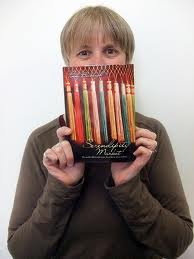
Penny Blubaugh, a teen librarian, describes herself as “the author of two sort-of-hard-to categorize teen novels. Serendipity Market is a retelling of fairy tales set in an off-kilter world that gets pulled back on track by the power of storytelling. Blood and Flowers is the story of the Outlaw Puppet Troupe. When they’re accused of illegal activity they’re forced to flee to Faerie, a place that’s never quite what you think it might be.”
She studied at Vermont College and was a graduate from their first class in Writing for Children. While there, she worked with Chris Lynch, Jackie Woodson, Chris Raschka, and Ron Koertge.
She says, “Before I started to write like it meant something I worked in grocery stores, banks, a department store. I was stuck in retail city! I was also a flight instructor, one of my best jobs ever!”
Penny, who lives in Chicago, will be co-presenting on a panel at the AWP conference on Friday, March 2 from noon to 1:15 pm, along with me (Ann Angel) and my ALA 2011 YALSA award recipient Janis Joplin, Rise Up Singing; Ricki Thompson, author of City of Cannibals; and Daniel Krauss, ALA’s 2012 Odyssey winner for his novel Rotters, on “How Far is Too Far? Facing Self-censors ad Publishing Censors When Writing About Coming of Age for Young Adults.”
I should make a point to say that a number of Pirate Tree authors will be presenting on young adult panels at the conference including our own Jessica Powers, whose This Thing Called the Future made ALA’s 2012 Best Fiction for Young Adults list.
Meanwhile, to give readers a taste of events at the conference I asked Penny to share a few of her thoughts about the topic as it applies to writing and editors here:
Be bold. Be bold. But not too bold.
Serendipity Market is a collection of fairy tale retellings told from slant or alternative perspectives. It’s set in a world that, when it shifts off track, is righted by people coming together to share their stories and their humanity. Tellers are invited to the market by Mama Inez, the woman who lives in the house with the witch’s hat roof: the woman who knows when the world needs fixing, and knows that this kind of gathering is the balm for the world’s ills.
When I was writing this book I found myself one story short. I needed at least 40,000 words and I just wasn’t there yet. I’d pulled from so many favorites – Cinderella, Jack and the Beanstalk, the Elves and the Shoemaker. I’d put in Little Red Riding Hood, Wynken Blinken and Nod, and even the legend of Pecos Bill. What next?
I started digging through tales and legends, looking for the spark to get me started. And then I remembered Mr. Fox. The moon-silver road through the woods. The handsome man who owned the mansion at the end of that road. The message over the front door – Be bold. The carved staircase that leads upstairs. Be bold. Be bold. The closed door at the top of the stairs. Be bold. Be bold. But not too bold. The room behind the door filled with vats of hair and blood and body parts. The brave girl who saves herself from the fate of Mr. Fox’s previous conquests.
I was thrilled. The story had everything, plus it would give a nice edge to the collection. I wrote and I polished and I sent it off. I’d reached my word count and I was pleased with the variety in the book, the way the stories played off of each other.
Then I got the email. Could Mr. Fox be taken out? It didn’t seem to fit with the rest of the book. What could I replace it with?
I looked at the email in some despair. Another story? Find something else that I wanted to work with?
So what did I do? I could have fought for Mr. Fox, but, as you’ve probably already guessed, that’s not what I did. This was my very first novel that was going to be published! My name would be on a book. If I fought back, what would that mean? Would I lose my chance to hold that book in my hands? I wasn’t willing to find out. Instead, I started rifling through fairy tales and legends again.
I settled on Tam Lin, something I’d initially rejected because it was seemed so complete in itself that I wasn’t sure what I could do to make it fresh. I finally decided to make the girl who saves Tam Lin the daughter of his best friend, the one who was with him on the night when he was taken by the Queen of the Faeries.
Tam Lin (called “Carter House” in the book) worked. It even became a sort of bridge piece in the middle. It’s the longest story and it seems to sit at the top of the bell curve, helping to tie together what comes before and after. But the whole exercise made me wonder. Was this a stronger book without Mr. Fox’s blood and gore? Was that even the reason Mr. Fox was rejected in the first place? I didn’t know because I never really asked. I just did.
I’ll never know for sure if Serendipity Market is better or worse with Mr. Fox on the sidelines. All I’ll know is that it’s different. And that brings up another question. How does an editor affect writing? I think they always make it better. It shines and sings after a few good back and forth rounds. But editors also make changes. So here’s the biggest question of all. How much change can you live with?
Be bold.
4 comments for “Be Bold! Thoughts on Self-censors and Publishing Censors”