Author/illustrator/storyteller/recovering-teacher/poet, Linda Boyden has written six and illustrated five picture books, The Blue Roses, Powwow’s Coming, Giveaways: An ABC Book of Loanwords from the Americas, Boy and Poi Poi Puppy, Roxy Reindeer, and Boy and Poi Poi Puppy in Doggone! She has had many poems published in various literary journals. She belongs to the Society of Children’s Book Writers and Illustrators, Wordcraft Circle of Native Writers and Storytellers, and Writers Forum of Redding CA. She says, “I spoil kids and grandkids. I write. I teach. I color in or outside the lines. 2016 is my fifth year of writing a poem a day. Poetry gives voice to our silent songs.”
Nancy Bo Flood lives on the Navajo Reservation where she writes, hikes, and attends local rodeos. Her award-winning books include: Navajo Year, Walk Through Many Seasons (Arizona Book Award), Warriors in the Crossfire (Colorado Book Award, YALSA), No-Name Baby (Bank Street’s 100 Best Children’s Books of 2012; Horn Book’s top choice historical novels). Cowboy Up, Ride the Navajo Rodeo, a recent poetry-nonfiction, is a Library Guild selection. Visit her at www.nancyboflood.com.
Lyn Miller-Lachmann is the author of the 2009 novel Gringolandia (Curbstone Press/Northwestern UP), a ALA Best Book for Young Adults and Americas Award Honor Book about a teenage refugee from Chile under the Pinochet dictatorship. Her 2013 novel, Rogue (Nancy Paulsen/Penguin), a Junior Library Guild selection, portrays a young teenager with Asperger’s and an X-Men obsession in search of a friend and her own special power. Surviving Santiago, the companion to Gringolandia, was published by Running Press in June 2015. Lyn translated the picture books The World in a Second (Enchanted Lion, 2015; a Kirkus and Boston Globe Best Book of 2015), Lines, Squiggles, Letters, Words (Enchanted Lion, 2016; a USBBY Outstanding International Book); The Queen of the Frogs (Eerdmans, 2017); Three Balls of Wool (Enchanted Lion, 2017; a 2018 Skipping Stones Honor Book); and Olive the Sheep Can’t Sleep (Charlesbridge, 2018) from Portuguese to English. Visit her at www.lynmillerlachmann.com.
Sarah Marwil Lamstein, former teacher, librarian, and puppeteer, is the author of four picture books, a middle grade novel, co-author of a Nepali folktale collection, and a poetry chapbook. Her picture books include Big Night for Salamanders, a Smithsonian Notable Book; Letter on the Wind/A Chanukah Tale, Sydney Taylor Honor Award; I Like Your Buttons! a Bank Street College of Education Best Book for Children; Annie’s Shabbat, a Booklist Top Ten Religion Book for Youth. Her middle grade novel Hunger Moon, set in the 1950’s, shows sixth grade Ruthie struggling to make her way in a dysfunctional family, which includes a brother beset with Aspergers at a time when there was little awareness of the disorder. On the making of her Nepali folktale collection, From the Mango Tree, she collaborated with Nepali writer Kavita Ram Shrestha. Her poetry chapbook, Breathless, was published by Finishing Line Press. To learn more about Sarah and her books, visit www.sarahlamstein.com
Peter Marino is an English professor at SUNY Adirondack. His novels for young adults Dough Boy (2005) and Magic and Misery (2009) have been nominated by the American Library Association for Best Books for Young Adults. Magic and Misery made Booklist’s Top 10 Fiction for Youth (2010) and the ALA Round Table’s Rainbow Books Bibliography.
J.L. Powers is the award-winning author of several books, most recently a YA novel she co-wrote with her brother, M.A. Powers–Broken Circle. She is also the author of a picture book, Colors of the Wind: the story of blind artist and champion runner George Mendoza , illustrated with Mendoza’s artwork. She is also the author of several young adult novels: The Confessional (2007), This Thing Called the Future(2011), a coming-of-age novel set in post-apartheid South Africa, and editor of That Mad Game: Growing Up in a Warzone, an anthology of essays from around the world (2012). Her novel Amina(2013) was published in Australia and explores a girl graffiti artist growing up in Mogadishu, Somalia. Visit her at www.jlpowers.net.
Padma Venkatraman is the author of three critically acclaimed novels: A TIME TO DANCE, ISLAND’S END and CLIMBING THE STAIRS, each of which was released to multiple starred reviews. Cumulatively, her books have several awards and been honored with inclusion on over fifty best book lists. Her 4th novel, THE BRIDGE HOME, is about homeless children in India and is scheduled for 2019 Spring release by Nancy Paulsen Books. She enjoys teaching and mentoring and visiting schools and has presented keynote addresses at national and international conferences. Visit her atwww.padmavenkatraman.com and @padmatv.
E.M. Kokie, Terry Farish, Varian Johnson, and Ann Angel all gave of their time, passion, heart and soul in the past to The Pirate Tree and we gratefully acknowledge their help and much needed contributions both to The Pirate Tree and also to children’s literature.
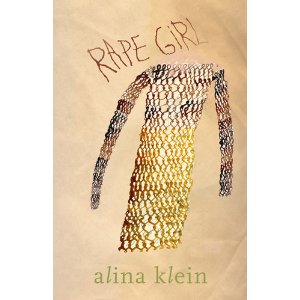 Not long ago, a Republican candidate for the U.S. Senate, Todd Akin, made a medically ludicrous and morally objectionable statement about “legitimate” rape and the chances of a woman becoming pregnant afterward. His remarks and the controversy afterward make the recent release of Alina Klein’s Rape Girl (namelos) especially timely and important. Klein’s short novel packs a big punch, as it explores the aftermath of a 16-year-old girl’s rape by a classmate.
1 comment for “What’s “Legitimate” About Rape? A Review of Rape Girl”